
In Abraham Maslow's theory of the hierarchy of human needs, shelter is identified as a cornerstone of security and a stable life. Buying a home is not only one of life's most consequential decisions but also the most “classic” way for a household to build wealth. From a basic human need to a foundational pillar of development, this exceptional asset carries the power to move an entire economy and society. Internationally, housing affordability is measured against household income. In developed countries, housing is considered "affordable" when a household spends roughly 30 percent of its monthly income on housing costs. In professional terms, this is described as being "in line with household income."
A wealth of research shows that when the monthly payment on a mortgage-or the cost of rent-exceeds 40 percent of household income, the household budget comes under strain. In Mongolia, the first steps toward building a housing finance system aligned with household income began in the mid-2000s. That effort gained an institutional "owner" in 2006 with the establishment of Mongolian Mortgage Corporation (MIK) HFC LLC. Then, when the Affordable Housing Finance Program launched in 2013, household-income-aligned housing finance became a tangible reality in people's lives.
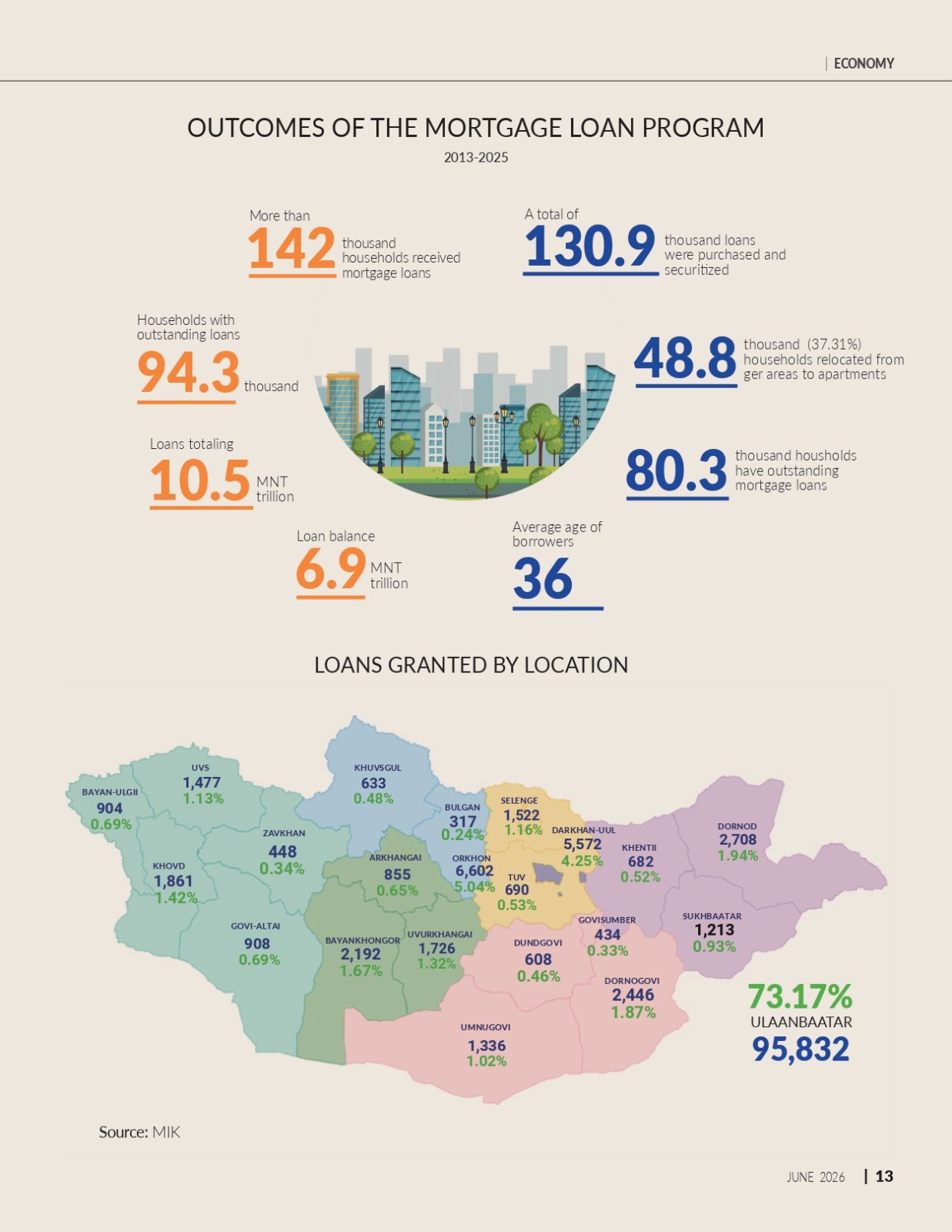
Since the program's launch, 142,000 households have taken out mortgage loans totaling MNT
10.5 trillion, according to a Bank of Mongolia report. Most importantly, these households are making very manageable monthly payments on their mortgages without falling into a debt trap. Borrowers under the subsidized loan program typically pay between MNT 400,000 and MNT 800,000 per month. On the other hand, according to the National Statistics Office (NSO) fourth-quarter 2025 data, average monthly household income was MNT 3.0 million in rural areas and MNT 3.4 million in the capital. By that measure, it is entirely fair to say that monthly mortgage payments are in line with household income. Even so, the mortgage finance system still faces many challenges that must be resolved. The greatest of these challenges is access to credit. Subsidized loans are funded by the Government, the Bank of Mongolia, and commercial banks.
More than 40,000 people are currently on the waiting list for mortgage loans, and meeting their requests would require MNT 6 trillion, as Minister of Urban Development, Construction and Housing E. Bat-Amgalan has pointed out. As for MIK, of the 142,000 household loans, it has purchased and securitized more than 130,000. It has also raised USD 775 million by issuing bonds on international capital markets three times. However, it is not feasible to fund "six percent mortgage loans" with dollar-denominated funding that carries a defined cost. For this reason, MIK channels the funding it raises on foreign markets into banks' market-rate mortgage loans. By their very nature, banks rely on short- and mediumterm funding sources. By strengthening banks' capacity with long-term funding, MIK proves itself the ecosystem's most important connecting player.
Going forward, if MIK receives meaningful support in raising funds from foreign markets, or if the central bank and the government cover its swap costs-the market interest rate on housing loans could fall to 12 percent.
In turn, the waiting list for subsidized loans would shrink. MIK CEO B. Gantulga emphasized this point in an interview, while Mongolian Bankers Association President O. Khurelbaatar expressed the view that "introducing a tiered, multi-option structure for mortgage interest rates would be a sound approach."
The Affordable Housing Finance Program launched in 2013 has had a positive impact not only on citizens' quality of life but also on society, the economy, and the environment. The driving force behind this positive change is "affordability." Affordability is the foundation of everything. In the housing market especially, it is the crucial thing to watch and measure. No matter how many houses are built, if household income is not able to afford to buy it, no real demand will emerge in the market. That is why, when household income, housing prices, and long-term financing find their balance, owning a home ceases to be a dream and becomes an attainable goal. After all, as long as everything stays aligned, growth will continue.
The Value Created
The housing finance system that took shape over the past 20 years has driven growth across many sectors. Notable progress in finance, construction, and real estate has, in particular, contributed to the expansion of the GDP. According to theNSO statistics, the construction and real estate sectors have each expanded fourfold since the program began. As of 2025, construction sector's contribution to GDP reached MNT 3.45 trillion, while the real estate sector's grew to MNT 4.23 trillion.
Since the Affordable Housing Finance Program began, an average of 19,000 new housing units have been completed in Mongolia each year, and 65 percent of the capital's housing stock has been newly built, according to MIK. Nationwide, the floor area of newly completed housing has increased by 4.8 million m² since 2013; a sharp rise compared with the period before the program began. Mortgage borrowers are free to choose between new and existing housing. The total floor area of homes they have purchased amounts to 6.6 million m². That is equivalent to 214 Sukhbaatar Squares, or 929 football pitches.
Alongside the Affordable Housing Finance Program, another major initiative that has taken root in the market is securitization.
MIK carries out this activity within a legal framework. Through its special purpose companies, MIK had securitized mortgage loans worth MNT 8.5 trillion on the domestic market by the end of 2025. In doing so, it has created the largest and longesttenor capital flow in Mongolia's financial sector. Before long, MIK Asset Forty SPC will securitize a substantial volume of loans. In addition, MIK has issued bonds on international markets three times since 2019, marking major progress for the finance system. This experience of attracting capital from foreign markets will undoubtedly fuel the system's further development.
When Times Turned Anxious…
During the COVID-19 pandemic, the Government decided to defer borrowers' payments without accruing interest, so as not to burden citizens' incomes and household finances. Accordingly, MIK partnered with the Bank of Mongolia to defer borrowers' payments five times without accruing interest, and went on to cover MNT 396.1 billion in coupon payments owed to bondholders out of its reserve fund. In that difficult time, the company saved a lot of money for 190,000 borrowers. Eighty-seven percent of borrowers applied to defer their loan repayments, and citizens were relieved of payments for two years-32 months in all-making this one of the defining episodes in MIK's history.
Borrowers may not always realize that, as MIK lifted the burden from their shoulders, it took that very burden onto its own. Behind all of this, MIK has continued to meet its obligation to make coupon payments to its bondholders to this day. Had there been no reserve fund, the Government's decision to defer loan repayments could not have been possible. Otherwise, the Government would have had to use nearly MNT 400 billion from the budget. Since the state budget is no different from the citizens' own, real support could come from only MIK. At the time, there were 28 special purpose companies under the "MIK Asset", all of which held reserve funds-and this is what protected households, the banking and financial sector, and investors from the financial risk that could have a serious effect on them.
Indeed, this history stands as the clearest proof that Mongolia`s mortgage system had matured in the fullest Sense.
MIK-and the system it has built-could further expand long-term mortgage financing if connected with institutional investors such as pension funds, provident funds, and insurance funds. And by attracting cheaper, domestically based funding, the scale of its operations would expand as well. Beyond this, MIK faces another major task: building a long-term financing system to support both the demand for and supply of green housing.